Rep. Sanford Bishop Scores 53/100: Life Support in Southwestern Georgia

Let us be precise about what 33 years in the United States Congress actually looks like in GA-2.
Albany, Georgia. Median household income: $32,000. Uninsured rate: one of the highest in the state. Healthcare provider shortage: severe. Life expectancy: below the national average by several years. Sanford Bishop has represented this territory since 1993. He has sat on the House Appropriations Committee since 2003. He controls the subcommittee that funds agriculture, rural development, and the FDA. He is, by every institutional measure, exactly the kind of long-tenured, senior appropriator that political science textbooks describe as the most powerful kind of congressman a poor rural district can have.
The district looks like it has never had one.
Rep. Sanford Bishop scores 53/100 on the Congressional Vitality Index, LIFE SUPPORT. Full methodology at dnrcongress.com/methodology.
The Machinery of Entrenchment
American political corruption rarely announces itself. It does not usually involve briefcases of cash or explicit agreements written on cocktail napkins. It operates through the patient accumulation of structural advantage, the kind that makes accountability mechanically impossible before anyone has technically done anything wrong.
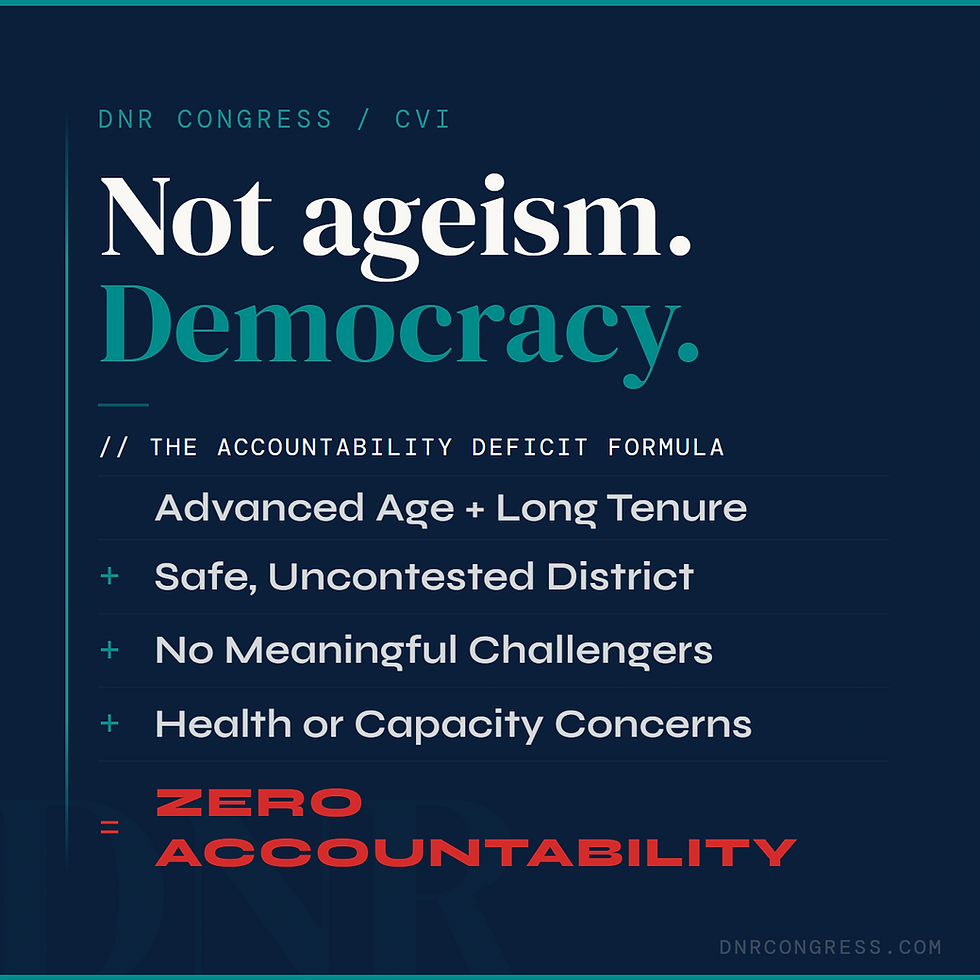
Bishop has been in Congress for 33 years. He has never faced a serious Democratic primary challenger. His campaign account functions as a deterrent. His seniority functions as a deterrent. His incumbency functions as a deterrent. The result is a representative who has not needed to answer a hard question from a primary voter in three decades. That is not democracy. That is the simulation of democracy, the retention of its forms while draining it of its function.
In 2024, Bishop ran without a Democratic primary opponent and faced a Republican challenger who had no realistic path to winning in a D+4 district. He won 56.3% of the vote. For a 33-year incumbent with no credible opposition, that number is not a mandate. It is a floor. Roughly 44% of GA-2 voters chose a candidate with no real chance of winning over the man who has represented them for three decades. They had no other option. The primary, the one moment where dissatisfied Democratic voters could have made a meaningful choice, was uncontested.
What "No Finding of Intentional Wrongdoing" Actually Means
In 2010, the Associated Press reported that between 2003 and 2005, Bishop directed Congressional Black Caucus Foundation scholarships to recipients who did not qualify for them. Among the recipients: his stepdaughter and his wife's niece. He pledged repayment. Citizens for Responsibility and Ethics in Washington placed him on its Most Corrupt Members of Congress list in 2011. No charges were filed. The matter was resolved.
In February 2020, the Office of Congressional Ethics transmitted a formal referral to the House Ethics Committee. The finding: "substantial reason to believe" Bishop had converted campaign funds to personal use. The documented expenditures were specific: golf club memberships, green fees, meals at two exclusive clubs, vehicle fuel for Bishop and his wife, all charged to the campaign account. Bishop repaid costs, fired his campaign treasurer of 26 years, and hired an outside compliance firm. The investigation ran for four years. It closed on December 30, 2024, at the end of a congressional session, bundled with three other investigations, with no finding of intentional misconduct.
Here is what "no finding of intentional wrongdoing" means in practice. It means the investigation concluded. It does not mean nothing happened. Golf club memberships were charged to the campaign. They were charged by a treasurer Bishop employed for 26 years. Bishop repaid the money. These are facts, not allegations. The scholarship money went to his stepdaughter and his wife's niece. He repaid it. These are also facts.
Two separate episodes. Two sets of family connections. Funds moved in a direction that benefited people close to Bishop. Funds repaid when scrutiny arrived. No finding of intent. The pattern is the point.
The Ledger
GovTrack records 727 missed votes out of 20,850 cast since 1993. That is a lifetime rate of 3.5% against a House median of 2.1%. During the 118th Congress, Bishop introduced the second fewest bills of any Georgia delegation member. His output was too low for GovTrack's algorithm to generate a standard leadership or ideology score. He has been in Congress since the first Clinton administration. He has occupied a seat on the Appropriations Committee for over 20 years.
In January 2025, he was one of 46 House Democrats who voted with every Republican present to pass the Laken Riley Act, a bill that mandated the detention of undocumented immigrants accused of theft or burglary, regardless of whether charges had been filed. That is the kind of vote a member takes when he is not particularly worried about his left flank, because his left flank has never had anywhere else to go.
The Underlying Condition
The Appropriations Committee is supposed to be the instrument through which Congress directs federal resources toward the people who need them. That is what it exists for. Sanford Bishop has served on it for 23 years. He currently ranks as the Ranking Member on the subcommittee responsible for agriculture, rural development, and the FDA. His district contains some of the most persistently impoverished counties in the southeastern United States. Counties where infant mortality is elevated. Counties where the nearest hospital has closed. Counties where the median household income has not recovered the ground it lost in 2008.
Institutional seniority of this magnitude, deployed over this length of time, in a district with these needs, should produce visible results. The question worth asking is not whether Bishop has worked hard or whether he is a decent man. By most accounts he is both. The question is whether a representative who has faced no meaningful electoral pressure for 33 years is the best possible version of the representative this district could have. The answer to that question requires a primary. GA-2 has not had one in a generation. The CVI score of 53/100, LIFE SUPPORT, is the numerical expression of what that absence costs.
The Challenger
Danny Glover is 37 years old, a community activist from Macon, and has never held elected office. He has filed to run against Bishop in the May 19, 2026 Democratic primary. He does not have a substantial fundraising base. He does not have institutional backing. He does not have name recognition beyond his home county.
He has something else. He has said directly, in public, that age is a legitimate issue in this race, that the party has spent too long tiptoeing around it, and that 1992 is not a credential for 2026. He is 41 years younger than the man he is challenging. He is asking voters of GA-2 to consider whether the district they live in is the best version of what 33 years of seniority can produce, and whether anyone should be allowed to go unchallenged for three decades simply because the machinery of incumbency makes challenging expensive and difficult.
That is not a radical argument. It is the foundational argument for competitive elections. The question is whether GA-2 voters will treat May 19 as the accountability moment it is.
Edit: Danny Glover has withdrawn from this race without statement.
The Diagnosis
Thirty-three years. Two documented episodes of funds moving toward family members or associates. Repayments both times. A four-year formal ethics investigation. A missed vote rate above the House median. The second lowest bill output in the Georgia delegation. A district that by every public health and economic measure has not been transformed by the seniority of the man it keeps sending to Washington.
CVI Score: 53/100, LIFE SUPPORT.

Comments